Society and Salvation: Witness to the Responsibility of a Middle Community
(January 25, 2026)
Note:
This public address, delivered by Imam Earl Abdulmalik Mohammed announces an expansion of weekly programs under the Muslim American Ministry for Human Salvation, now occurring every Sunday. The address emphasizes Islam’s public concern for human dignity, moral balance, and societal stability, critiquing contemporary leadership failures and deceptive influences undermining justice.
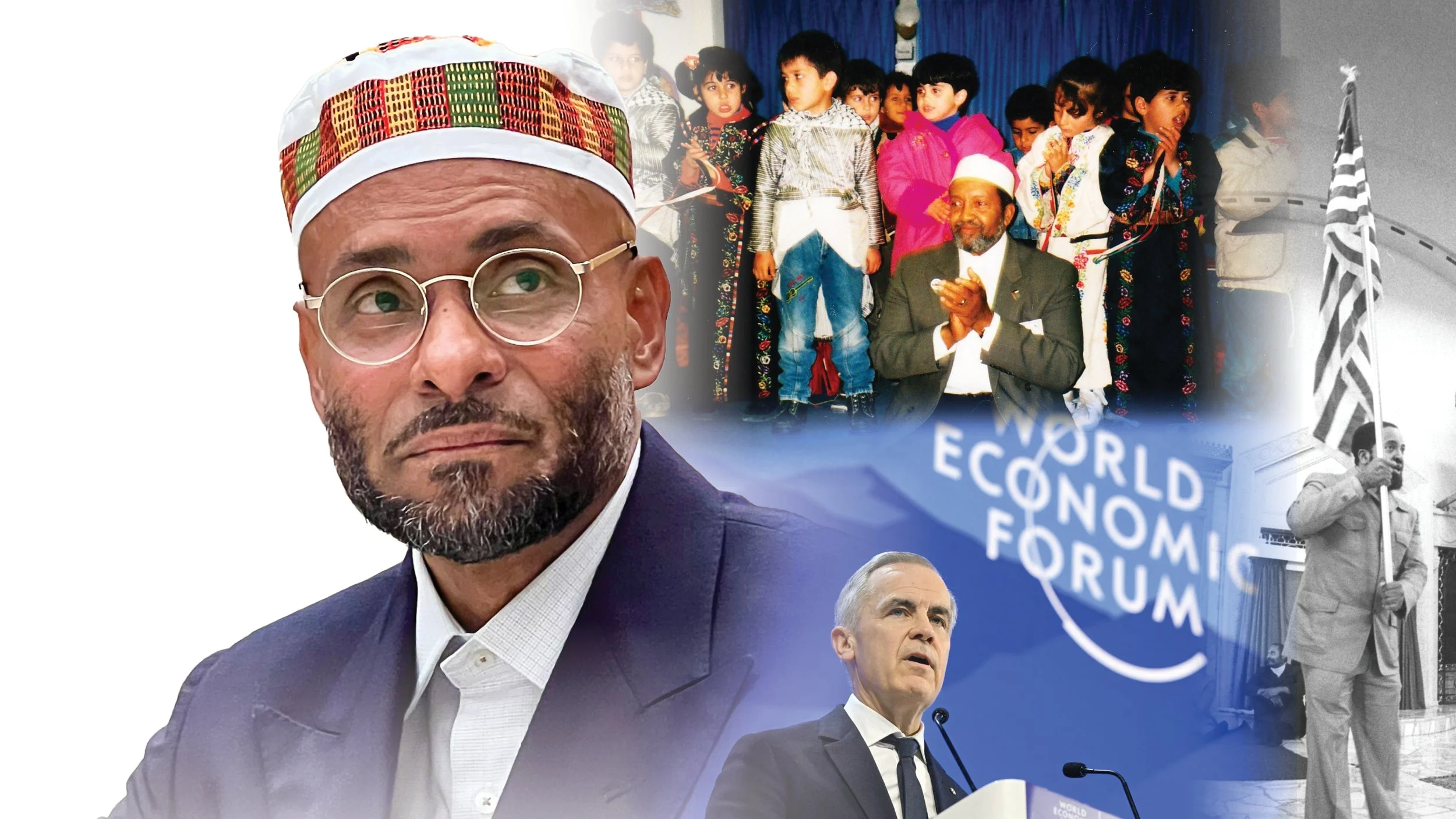
Drawing on Quranic principles—especially the concept of a “middle community” (balance, justice, and symmetry)—the Imam Earl Abdulmalik Mohammed urges Muslim leadership and broader society to witness and act upon divine guidance to safeguard human life, referencing the World Economic Forum and Mark Carney’s “middle power” framing as resonant with Islamic doctrine.
He highlights universal human honor, racial and ethnic equality taught by Prophet Muhammed, and the necessity of rational, precise, and action-oriented worship, culminating in a call to reclaim moral witness and uphold balance for the salvation of America and the world.
The content creation date is 2026-01-25, so the “recent” World Economic Forum mentioned refers to the immediately preceding week relative to that date.
IBRAHIM EL-AMIN (Assistant and Representative of Imam Earl Abdulmalik Mohammed and MAMHS): Praise be to G-d. We greet you with the greetings of peace, As-salaam alaikum, peace be upon you all. We would like to welcome you to a public address by Imam Earl Abdulmalik Mohammed. Normally, in the past, we have conducted public addresses on this platform, in this manner, virtually, on the first Sunday of each month. On the second Sunday of each month, we have the Living in the Most Serious Times an ongoing discussion with Imam Earl Abdulmalik Mohammed.
After some consideration, we’ve decided to expand the frequency with which we come before you in this way to every Sunday, to the additional two Sundays of the month. This program is titled “Society and Salvation.”
The Muslim American Ministry for Human Salvation - our office, is a public office, and our concerns are public. Our desire to spread the message of Islam and its solutions for the ills of society is a public concern. And so we want to be as thorough as possible in terms of whatever ability we have to reach the public with our message.
The other two programs that we mentioned will continue as planned, and we look forward to your participation there, as well as your continued support.
We’re living in a very, very serious time at this moment, and it has been in the tradition of our community, of our leadership, of our establishments, to be vital contributors to the stability of society. And it is in that spirit that we come before you now.
It is a great honor of mine to introduce to you the leader of that tradition, Imam Earl Abdulmalik Mohammed.
EARL ABDULMALIK MOHAMMED (Muslim-American Leader):
Thank you, Imam Ibrahim. We greet our honorable audience with the words of greeting that Muslims greet each other, “As-salaam alaikum,” which is “peace be on you.” Peace be upon you. And we add to that, in the tradition of Muhammed the Prophet, the prayers and the peace be upon him -the human being to which the Holy Quran was given, revealed as a moral human exhibiting model human behavior upon the foundation of an inherent excellence. We add to that greeting the mercy of G-d and His favor and His blessings.
A Sacred and Public Concern
As Imam Ibrahim just described, our interests are not confined to the service of the Islamic community. In fact, Islamic identity suggests public interests, public concerns, a concern for the condition of man, human life. That is our focus. That is our intent. And the Muslim, in his and her true conscience, and I would say deliberate behaviors that are attached to that conscience, would not feel, or does not feel, fulfilled except that attention is given to the service of human life, the service of human communities, the service to the salvation of nations.
This is a sacred concern, a sacred responsibility. And for Muslims, it is repeated often in our readings, in our recitations, in our concern to embrace and promote the leadership of Muhammed, the Prophet. There is not any prayer that we make that does not concern itself with G-d’s attention to human life in His intent to salute man’s honor. That the creation of man is a salute to an inherent honor. And any calculation that intends to dishonor human life is ultimately doomed for failure.
That is our public concern. That is our public commitment.
Reflecting on the Burdened Condition of Human Society
We are reflecting -that is all Muslims of good conscience, and I would think all people of good conscience and goodwill. We are reflecting on the condition of human society. And we are reflecting on the difficulties, the burden and confusion in messaging that is coming from leadership. We are reflecting on that.
It was once expected in this country, these United States of America, that our government leaders held themselves accountable to a general rule of decency. They held themselves accountable to the promotion of policies that were directly connected to the founding perspective and ideas of the nation, of the country.
To a disturbing measure, that concern on the part of government leaders, that attention to sacred principles that have historically characterized at least the intent in leadership of American society, that emphasis, sadly and disturbingly, has been lost.
We can identify movements in the spiritual orientation of man that are responsible, even more than government policies, political policies, or you could say economic policies; the interests, the specific interests of governments in representation of their own people, and perhaps in their estimation service to their own people; we can identify spiritual influences that are directly responsible for this failure. And it would be our responsibility to reflect upon these influences and to address them.
It is in the tradition of Muslims that we say we seek protection with G-d from the influence, the harm, of the enemy of man. The presentation of the enemy of man in our religious traditions and teachings is as a deceiver. This is one of his attributes, and as a whisperer. He’s also referred to as an open adversary and one that seeks the throne of authority over the life of mankind. He surreptitiously questions and makes fun of the dignity of man, the potential excellence of man, and he treats the question or the concern of a moral destiny as a ridiculous notion. He trivializes it. He ridicules it. He questions its very existence in the conscience of human life, the conscience of man.
And so, his tricks of deception and his influence, as it becomes manifest in the failures of governmental leadership, as it is manifest in the influences of confusion coming from leaders that have been charged with a trust; we see that their communications bear the mark, the influence, and even in some cases bears an alliance with the intent to deceive and to undermine the dignity of humankind.
So, with this as a serious matter of consideration for the stability and security of human society, it is absolutely essential that those that are given and have acquaintance with and have embraced Divine Guidance, that we bear witness to that Guidance and that we repeat that Guidance into the discussion for the direction and salvation of human life.
The Formal Islamic Prayer Suggests Attention on Human Society
In our rituals as Muslims, we have a spiritual practice that is known, shared and practiced by all of the heavenly religions, all of the people of faith; that is the spiritual practice of prayers. For Muslims, there is a formality to our prayers. Perhaps in other religious traditions prayers are more a function of the emotional nature and not always the rational nature of human life. But for Muslims, there is a formality that emphasizes the rational interests of human life, and it carries with it a moral disposition and a moral focus.
In that formality is a precise recitation of our Scripture, of our Holy Book, a precise recitation. It is not acceptable to make any errors in that recitation. This formality invites corrections of the reciter as a responsibility of the learned or any person -male or female to make a correction of the reciter or leader if those recitations are imprecise. If we are not pronouncing the words correctly, or if we are not focusing the proper emphasis in those recitations, then within the ritual of our prayers as taught by Prophet Muhammed there is a space for that to be corrected. And all Muslims who are dutiful in their prayers are aware of the obligation of precision in our recitation.
As regards the application of what we are reciting, the obligatory precision is to say that we owe a strict attentiveness, a critical attentiveness, to matters burdening human life in society. This interest cannot be only a critique. This attention to precision suggests that we have a responsibility to insert our commitment, insert our knowledge, insert that which we regard as Guidance into the public discussion. And that we witness to the principles of what we are offering. That we don’t just repeat them or recite them. That we witness to them and act upon them.
Our prayer ritual is recitation of the words themselves, and between the recitations, it is expressions of acknowledgement of G-d’s authority. Within the space of all of that activity are gestures, actions and movements -all signaling commitments, that are not just of the intellectual interest but also of the physical, material nature and responsibility. We have tangible obligations to establish a perfect morality or at least a picture of perfect morality as testimony before G-d.
We are to engage society. We are to engage the issues. And we are to not accept that there is any condition in the life of man that is not our concern, to embrace as a responsibility, to lead mankind out of darkness into a condition of stability, certainty, security, balance, peace.
World Economic Forum of 2026 (Davos, Switzerland) and the Prime Minister of Canada
Recently, this last week, we heard from leaders at a world economic conference. And the conference was, I think, called the World Economic Forum. And the policies of nations with regard to the strengthening and weakening of the international economy, trade relationships, policy, are what is generally in focus at this annual meeting.
But it’s also an occasion for leaders to meet each other and to express themselves to the human family. And I am being very deliberate in referring to human beings as a family. This is of the influence of the Islamic teaching of Muhammed, the Prophet, that we are descended from a father, and that our father, and I’m going to make reference to this as we continue with this discussion today, that our father is one. We are speaking of Adam. This is the statement of Muhammed himself, and the Quran, as I have already indicated. The Quran says of our first ancestor that he himself was honorable, and that all of his descendants are honorable.
This World Economic Forum was a setting for the concerns of world leaders to be expressed and for the human family to witness those concerns.
As a part of that forum, there was the expectation that these leaders would put into focus, identify, the most pressing economic influences, economic concerns that threaten nations, that strengthen nations, and grab the attention of even the common populations of every nation on this earth.
The Middle Power Doctrine
In that forum, well-known and lesser-known leaders of nations offered their insights and considerations. One leader who, in my estimation, stood out was the leader of Canada, Mr. Carney. And he made a reference that reached me directly as a person sensitive to the requirements of Islamic identity. Not that he addressed Muslim populations or Muslim leaders, at least not with any specificity or by name; but he made a reference. And he repeated that reference several times. That reference was to the characterization of his nation, Canada, as a middle power.
He gave a definition in social and economic terms what he meant by that and outlined a kind of doctrine of conduct, or I might say he outlined an invitation to the acceptance of a doctrine of conduct on the part of nations and their leaders that would consider themselves middle powers.
It’s not my place nor do I want to dissect or survey Mr. Carney’s address. And I don’t want to interpret his meanings. I’m sure that the transcript of his address is available, and for persons who are interested, you can read that or hear his speech. I’m sure that it’s available or accessible. I’m not in any position to interpret his specific meanings. But his terms, his terminologies, as they are reflected as a concern in the general picture of the condition of man on this earth; his selection of that term, middle powers, is, in my mind, a serious and deliberate influence. It is a term that Muslims themselves can readily identify as a moral principle. I don’t know that Mr. Carney intended to reach with that language the Muslim world leadership. I can’t say that. But learned people in Islam would know that reference.
A Middle Community
G-d says in the Quran, the holy book of Muslims -and the Book is self-described as guidance for the regardful, the regardful of G-d. The Quran says of itself that it َis َ”guidance to the regardful of G-d.”
And it says, “And thus we have made you a middle community - a middle people, that you might be witnesses upon mankind, and that the Messenger be a witness upon you.”
The designation of the Muslim community as a middle community refers to a balance that there is in the sacred nature of creation -an inherent recognition and necessity for balance. And that to ensure success, that mankind must seek that balance, must establish his society upon that balance, and that there is no fulfillment for the purpose of human life except in that balance.
Muhammed the Prophet’s example, his exhibition of excellence, is within a symmetry. That symmetry suggests an equality, a measure by which standards are established for right and wrong. That measure is in the very nature of human creation, and supporting that, it is established within this scale of balance and symmetry, everything that G-d has created. That G-d has created an order, and that order is upon a balance. The concern for upholding what is just, the intent to establish justice, or just order or just society, cannot be separated from a recognition of this movement in human existence to sustain a balance.
Upholding the Balance
So here the verse from the Quran says that G-d Himself, in His interest in human society, established a middle people, a middle community, that has been charged with the responsibility to uphold the balance as a witness—a witness to the establishment of a moral life, moral interests, moral intent, moral influence that creates the necessary configuration for the balance of society and its existence.
It is not easy for me to say that the Muslim world, in its leadership, has lost attention and focus upon this requirement for its identity to promote the balance and to represent, as a witness to mankind, middle power concerns, not superpower concerns—middle power concerns; and to invite mankind, all nations, all leaders, to respect that inherent symmetry where nothing that concerns human life is out of balance.
This is a moral concern. This is an economic concern. This is a legal concern. This is a social concern.
This verse from the Quran that identifies Muslims as a middle community goes on to say that a witness and testimony-responsibility has been established in Islamic language, the language of our religious life and in our spiritual devotions.
Social Balance and the House at Makkah
All Muslims know that we turn in the direction of the sacred house at Makkah. That is our spiritual prayer orientation. But there’s a lot of social activity that is assigned to that orientation. To visit the House is a requisite of Islamic identity. We make pilgrimage to the House and we circumambulate the House.
This is one of the rituals of our visit to the House, that we go around it and that we engage one another. That is, all of the faces of mankind on this earth, that we are engaged together in those rituals, in that focus, in that attention calling upon our G-d, our Lord-Creator as His creation and servants.
And it is further a requirement that we assemble at a place that refers to a recognition of one another - Arafat. That we assemble there to seek the proper respect for human life in community-social identity. And that we depart from there with the spirit of a new social life to offer mankind.
This is our spiritual focus. The word that’s used in the Quran is “qibla.” It refers directly to our spiritual focus. But, as I’ve described, it also is a strong reference to our activity as a social creation aligned with a particular focus. Reference to this qibla is in the context of this middle community identity. That attention to the meaning of the qibla is associated with the maintenance of the balance, and this ‘middle community’ emphasis as a central element of Islamic identity.
The verse continues to say that the one that attends to the proper focus on this qibla in the context of maintaining middle community identity will be made known, and that the one that fails in that will also be made known. This is a reminder, but it is also, according to the word that is used in the Quran, a testing. And in a test there are failures and successes.
Middle Community Identity, the Palestinian People , and the African American People
With regard to the issue of the Palestinian people -giving attention to the dignity of that oppressed population: where is Muslim world leadership assigning to itself the responsibility to uphold middle community identity? And by middle community identity is meant the symmetry of justice and just order. Where is the voice of Muslim world leadership in upholding the principles of the balance?
Because of the conditions of the United States of America and its history, the challenge of the blessedness and the continuity of sacred ideas that were expressed into the life of man by the Founders of the United States—because of those claims—America has a special designation, a special history. And because of circumstances associated with that special designation, special history, as it applies to America’s denial to a people, a particular conscience was produced into the world. And that conscience, more than any other -its purpose, is a conscience that focuses on the inherent excellence and dignity of human life.
It has been expressed even coming from the tongue of uncultured, uneducated, disenfranchised, disrespected, burdened, enslaved souls. So profound in the creation of human life as a focus of attention for human life, so profound and weighty is it that it is even expressed in a people having no intellectual connection to movements of justice on the earth. That even a people separated from intellectual traditions for movements of justice have a share and claim on the principle America because of its founding idea.
A People Lost then Found
And the challenge to that idea in America’s history toward the African-American people; its treatment -deliberate and willful treatment, of a people produced a special sensitivity. That sensitivity first had expression coming from just the moral nature. But that expression eventually evolved and those people ‘lost’ to universal human recognitions and respect; ‘found’ a language environment that had latent in it the promotion of universal human identity according to designations given in the religion of Islam.
So what I am saying to you now is a reflection of that evolution and sensitivity: that the Muslim African American community, belonging to a tradition that began with a rejection of all temporal or worldly governing moral authority, a rejection in particular of white supremacist authority; then produced a connection to, a sacred connection to, the fundamental identity of man that is presented in the Quran. It evolved as a tradition and has since produced an expression, a language of understanding and representation, of the primary moral concern to address and fulfill the need for messaging of human salvation on the earth presently.
Super Power and Middle Power
Mr. Carney of Canada, in my estimation, connected with a universal spiritual sensitivity: that the salvation of man on this earth, in addressing the moral abuses of superpowers and superpower leadership, is to adopt the policy of middle community interests, balanced human interests, just human interests. That appeal, and the associated requirement of that appeal, will be enough to address the condition of oppression on this earth. Those that recognize the sanctity and the necessity of that middle identity can reform themselves. By reforming their own interests, they provide witness stability for the progress of human life -for the protection of human life, in spite of the extreme influences and extreme language and extreme error of world leaders with super power mentality or super power ambition.
An Honorable Standard
In another place in the Quran, G-d says that He “We created you from a single male and female, one soul, and made you into nations and tribes, that you will know one another. And the most honorable of you, that which distinguishes you, is a connection to the regardfulness of G-d’s purpose for your creation.
A regardfulness of G-d’s purpose for your creation—and this is given in a word that’s well known to Muslims. It has been translated “the fear of G-d,” taqwa: regardfulness, reference to G-d’s purpose for human creation, and the concern to measure up to that honorable standard, with G-d as a witness to your own inherent worth. And to be a witness on behalf of those who have been denied recognition of that worth, to be a witness to them.
Race, Ethnicity, and the Middle Community Order
This moral tradition and emphasis in Islam was further commented on by Muhammed himself. He addressed his following, identifying witness concerns, middle identity, middle community, middle power, that which orders society’s major considerations. He addressed his community on major considerations in his last appeal to them. And in that last appeal to them, he said to them, in commentary on this verse from the Quran, that your Lord is one, your origin, your father is one. That there is no particular favor conferred upon one member of the human family against another.
He was very specific. He said there’s no particular favor given to an Arab over a non-Arab. And the word that he used to describe the non-Arab doesn’t say non-Arab literally; it says alien, different, other. Other than that, in the consideration and respect for that which is associated with G-d’s creation in man’s focus and movement toward his destiny, that there is no difference or quality of difference or measure of difference between one associated with a particular national or ethnic identity over another that does not have that designation.
He went on further to put this argument in racial terms. He said that there is no superiority of a white over a black, no superiority of a black over a white. And he was very specific. There was no mystery or doubt as to what he was speaking of. He was talking about racial designations, skin color designations. He was talking about ethnic designations. He was talking about national designations. He was talking about class designations. And he was warning against the labeling of people so that they might be separated from a distinct group that saves for itself access to the provisions of life that support the beauty and excellence of life, that they have themselves an exclusive claim to those resources above another community.
Muhammed the Prophet warned against this, and he said further that the distinction, that which indicates a favor or a kind of superiority, is only to be referenced by that one that measures up to the purpose for which G-d created life itself, and that is an expression of decency and dignity before G-d, an expression of responsibility associated with that dignity and decency.
That G-d, when He created the first human, He created a guardian of human identity and human purpose. He created a trustee of the resources in everything that exists that He created other than man, that supports that inherent decency and dignity. He created a trustee to guarantee access. And within that identity, in its reach for establishment in society, is the middle community order.
The Doctrine of Human Life Sanctity is Salvation
The salvation for human society and the salvation of American society in this critical moment is the reclamation of moral witness to middle community identity and intent. We stand upon that symmetry. Within that symmetry is access to freedom and justice. Within that balance is a recognition of the dignity of every community. Within that balance is a restraint on aggressing upon, incurring upon, the inherent excellence and dignity of human life.
No immigration and customs enforcement (ICE) official or agent will act against that dignity if they have this recognition. But this recognition has to have a witness. It has to have a representative. And that representative can’t embrace this identity from an emotional standpoint only; it has to be embraced upon a doctrine of responsibility. And Muhammed the Prophet established that that doctrine of responsibility is a connection to recognition that when G-d created a human life, He created a valuable, respected, honorable entity.
Salvation for America, salvation for this world presently, is in the identification of the sanctity of human life in its purpose before G-d. We are witnesses to this. We stand firmly within this identity, and our measure of success in that movement toward salvation requires of us a certainty of commitment to upholding the balance.
Thank you. We thank G-d for this opportunity, and it is our intent to stand as witnesses through these addresses and in our public commitments to saving this country from the abuses of its misdirected, misguided present leadership. We have no greater responsibility in this time.
Thank you. Peace be on you. As-salaam alaikum.